

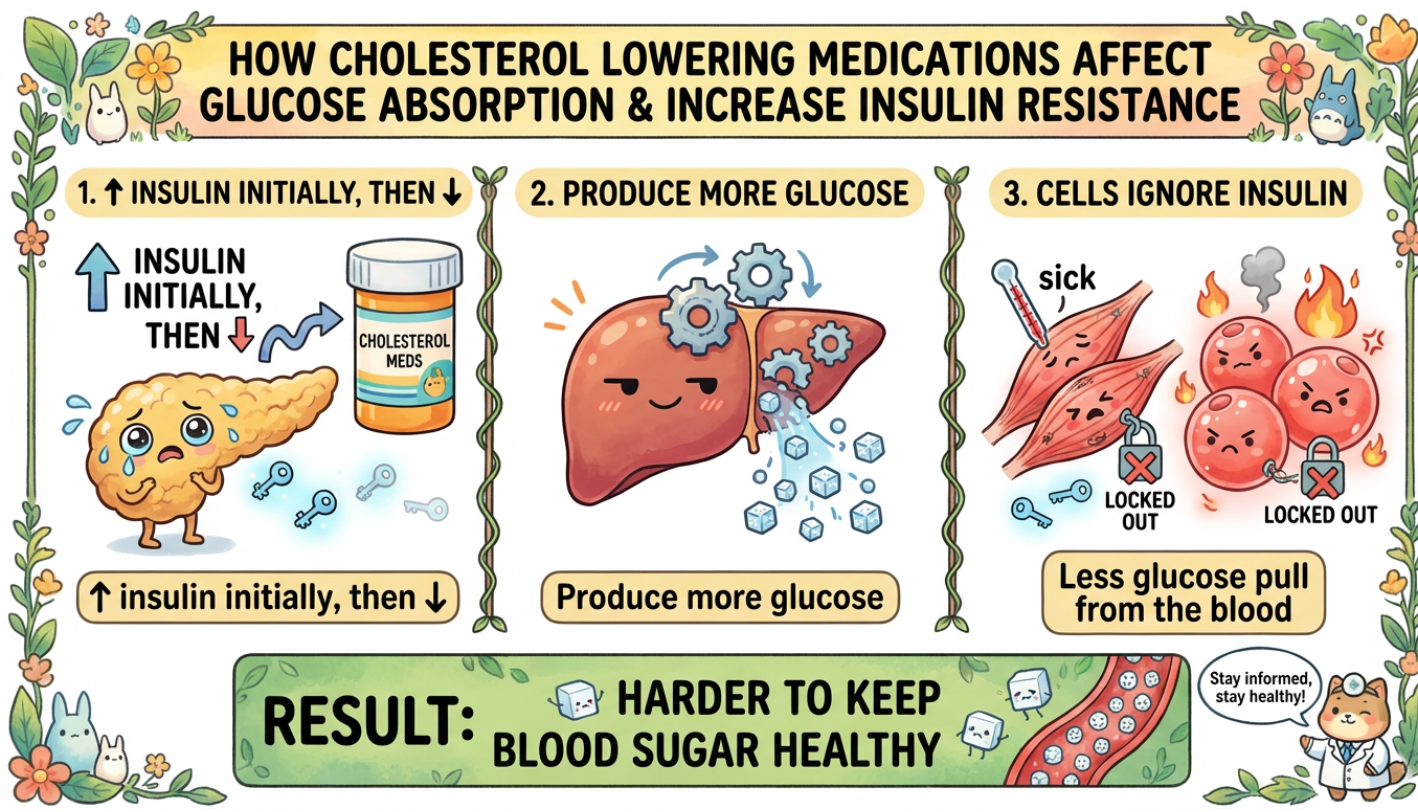
The Hidden Trade-Off: How Cholesterol-Lowering Medications Can Raise Your Blood Sugar
The Double-Edged Sword You Need to Know About
Statins are among the most widely prescribed medications for lowering cholesterol and reducing the risk of heart attacks and strokes. But they come with a well-documented downside: they can modestly increase your risk of developing type 2 diabetes.
You start a statin hoping to solve one problem high cholesterol, only to potentially face another problem: elevated blood sugar. That is the double-edged sword.
The Statin Diabetes Trap -How One Pill Creates a Never-Ending Medication Cycle
To manage the new blood sugar issue, you are often prescribed additional medications. Before long, you may find yourself trapped in a never-ending cycle of treating one side effect with yet another drug. Unfortunately, this is how moden medicine works
Just How Common Are Statins?
Statins are the most prescribed cholesterol-lowering medications in the United States. Around 35% of Americans, roughly 92 million people were taking statins as of 2018–2019. That is a sharp increase from just 31 million (12%) in 2008–2009, representing a 197% rise over the decade. Annual prescriptions grew from 461 million to 818 million during that same period.
Beyond Blood Sugar: Other Common Side Effects
While muscle pain is the most common side effect (affecting 1% to 10% of users), other frequent issues include:
Digestive problems (nausea, vomiting, diarrhea, constipation) in 1% to 7% of patients
Headaches in 2% to 17% of users
Fatigue in 1% to 4% of patients
Sleep disturbances and memory loss reported by some users
Elevated blood sugar or new type 2 diabetes, especially in those with prediabetes
How Statins Disrupt Your Body’s Sugar Control
👇[Download 6-Step Action Plan to Reverse High Blood Glucose & Bad Cholesterol Profile]
👇[ Download the Statin Survival Cheatsheet, which statins have less effects on your blood sugar]
👇[DOWNLOAD 8 WAYS TO LOWER YOUR RISK OF HEART ATTACK & STROKE GUIDE]
🔴 Pancreas – Makes Less Insulin
Statins interfere with your pancreas’s ability to produce insulin in several ways:
They remove cholesterol from the surface of insulin-producing beta cells. This is like removing a key ingredient from a recipe, the cells cannot properly sense sugar or release insulin when needed.
They lower your body’s levels of CoQ10, a natural substance that helps cells produce energy. Without enough energy, your pancreas cannot trigger insulin release effectively.
They disrupt internal signaling proteins that act like a chain of command inside your cells. When that chain breaks, the “release insulin” message never gets delivered.
The net result: Your pancreas releases less insulin than it should when your blood sugar rises.
🟠 Liver – Stores Less Sugar and Makes More Sugar
Statins make your liver ignore insulin’s signals:
Normally, insulin tells your liver, “Stop making sugar and start storing it.” But statins weaken this signal, so your liver does not get the message.
With a weaker signal, your liver absorbs less sugar from your blood and stores less as glycogen (stored energy).
Instead, your liver continues to produce and release new sugar into your blood, making blood sugar levels rise even higher.
Some statins also increase a protein called PCSK9, which may break down insulin receptors faster.
The net result: Your liver takes in less sugar and puts out more sugar.
🟡 Skeletal Muscle – The Major Block in Sugar Absorption
Muscles are the most important tissue for blood sugar control, and statins hurt them the most:
Statins remove cholesterol from tiny tubes inside muscle cells that are needed for calcium signals. Without those signals, muscles cannot move sugar transporters to their surface.
A protein called GLUT4 acts like a door that lets sugar into your muscle cells. Statins prevent that door from opening.
Statins lower CoQ10, which starves your muscle cells of energy. Without energy, they cannot absorb sugar well.
Muscles may start burning fat instead of sugar for energy, further reducing how much sugar they take in.
If statins also cause muscle pain or damage, that muscle is even worse at absorbing sugar.
The net result: Your muscles which normally absorb 70–80% of sugar after a meal stop doing their job.

🟢 Fat Cells – Poor Storage Leads to Sugar Spillover
Statins disrupt how fat cells manage sugar and fat:
They reduce adiponectin, a helpful hormone that fat cells release to make your liver and muscles more sensitive to insulin. Less adiponectin means worse insulin sensitivity everywhere.
They also reduce GLUT4 in fat cells, so even fat cells cannot absorb sugar properly.
When fat cells cannot store fat well, that fat spills over into your liver and muscles. This extra fat makes those organs even more insulin resistant.
Statins can also lower activity of PPARγ, a master switch that helps fat cells mature and stay sensitive to insulin.
The net result: Fat cells do not store fat or sugar properly, which worsens insulin resistance throughout your entire body.
The Big Picture
Statins cause two major problems for blood sugar control. First, they make your pancreas release less insulin. Second, they make your liver, muscles, and fat cells ignore the insulin you do have.
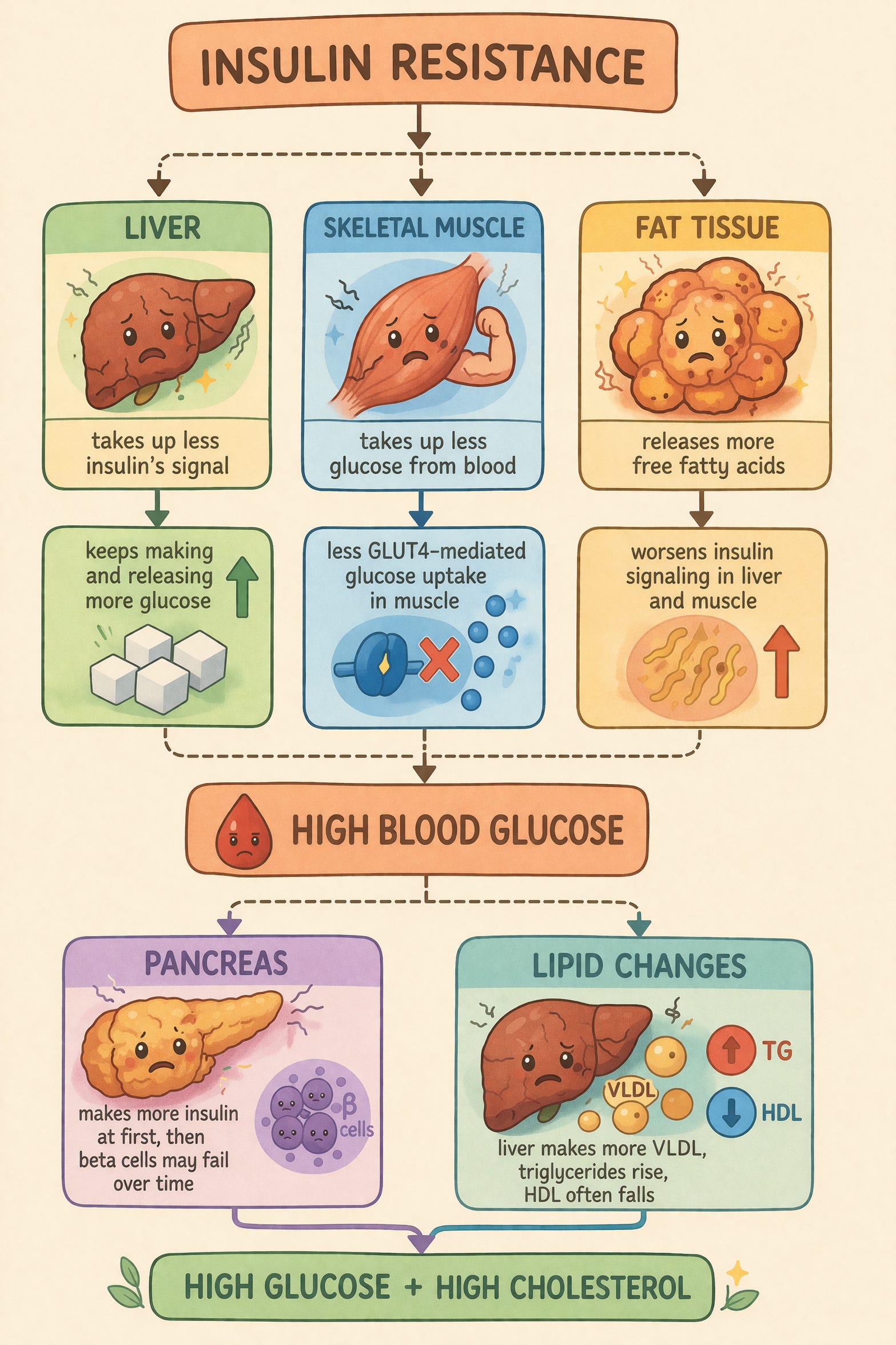
Your liver keeps making sugar, your muscles would not absorb sugar, and your fat cells spill fat into places it should not be. All of this adds up to higher blood sugar and a higher risk of developing diabetes.
What did the research say?
The Large Population Study (2025)
A large 2025 study of over 119,000 healthy people found that statin users were nearly 7 times more likely to develop diabetes than non-users, and those with normal blood pressure faced more than double the risk.
The researchers followed over 119,000 healthy people (no diabetes and no heart disease) for one year to see how statins affected their risk of developing type 2 diabetes.
In people not taking statins, less than 1 out of 100 developed diabetes that year (0.3%). But in people taking statins, more than 2 out of 100 developed diabetes (2.2%). That is nearly 7 times higher.
For people with normal blood pressure - the risk was even more striking. Statin users were more than 2.5 times more likely to develop diabetes compared to non-users.
Even in healthy people with no diabetes or heart disease, taking statins significantly increases the risk of developing type 2 diabetes especially for those with normal blood pressure.

The Dose-Intensity Study (2024)
A 2024 Korean study of over 6,000 heart attack patients found that high-dose statins caused more new diabetes cases than moderate-dose statins proving that higher doses mean higher diabetes risk.
In South Korea, scientists followed over 6,000 patients who had suffered a severe heart attack (acute myocardial infarction). All patients received a stent to open their blocked artery (PCI) and were prescribed either atorvastatin or rosuvastatin (two common statins). Some received a high dose, others a moderate dose.
Patients taking high-intensity (high dose) statins developed new diabetes at a significantly higher rate than those taking moderate-intensity (standard dose) statins.
The higher the statin dose, the greater the risk of developing diabetes. This is called a dose-dependent effect - meaning more medication leads to more of this particular side effect.
Even in people recovering from a heart attack, high-dose statins increase diabetes risk more than moderate-dose statins. The benefit of preventing another heart attack must be weighed against this risk.
The First Warning Signs (PROVE-IT & A to Z)
The PROVE-IT and A to Z trials were the first to discover that the popular statins atorvastatin (Lipitor) and simvastatin (Zocor) can raise blood sugar and cause new cases of type 2 diabetes.
Two landmark trials PROVE-IT TIMI 22 and the A to Z trial were the very first to sound the alarm that statins could raise blood sugar and lead to diabetes.
What PROVE-IT TIMI 22 found: This was the first study to report that atorvastatin (brand name Lipitor) caused increases in:
Fasting blood glucose (blood sugar)
HbA1c (a measure of average blood sugar over 2–3 months)
New cases of type 2 diabetes
The second part (Phase Z) of the A to Z trial reported similar blood sugar increases for simvastatin
These were the first warning signs that two of the most popular statins - atorvastatin and simvastatin could raise blood sugar and trigger diabetes in some patients.
Before these studies, the link between statins and diabetes was not widely recognized. These trials were the pioneering evidence that put this side effect on the medical community’s radar.
What are the natural alternatives based on research studies?
👇[Download the 6-Step Action Plan to Reverse High Blood Glucose & Bad Cholesterol Profile]
👇[ Download the Statins Cheatsheet, which statins have less effects on your blood sugar]
👇[DOWNLOAD 8 WAYS TO LOWER YOUR RISK OF HEART ATTACK & STROKE GUIDE]
Other posts:
Unlock the Hidden Truth About Your Cholesterol Labs
Are Your Cholesterol Lowering Medications Sabotaging Your Health?
They Lied to You About Cholesterol
This Man Ate 25 Eggs a Day for 15 Years. What happen?
Is Your Doctor Missing This #1 Life-Saving Blood Test?
The #1 Hidden Cause of Heart Disease (It’s NOT Cholesterol!)
Metabolic Syndrome: The Silent Killer Behind Heart Disease, Stroke & Diabetes
4 Shocking Cholesterol Myths: Why Lowering Cholesterol Won’t Save Your Heart
3 Easy Ways To Get Rid of Bad Cholesterol Naturally
The Hidden Secret to Lowering Cholesterol You Need to Know
The Diabetes - Heart Attack Link: Why Your High Blood Glucose Is a Silent Killer?
This guide is for informational purposes only. Please consult with your healthcare providers before making any changes to your medication regimen. These statements have not been evaluated by the Food and Drug Administration (FDA). These statements are not meant to diagnose‚ treat or cure any disease or medical condition.